
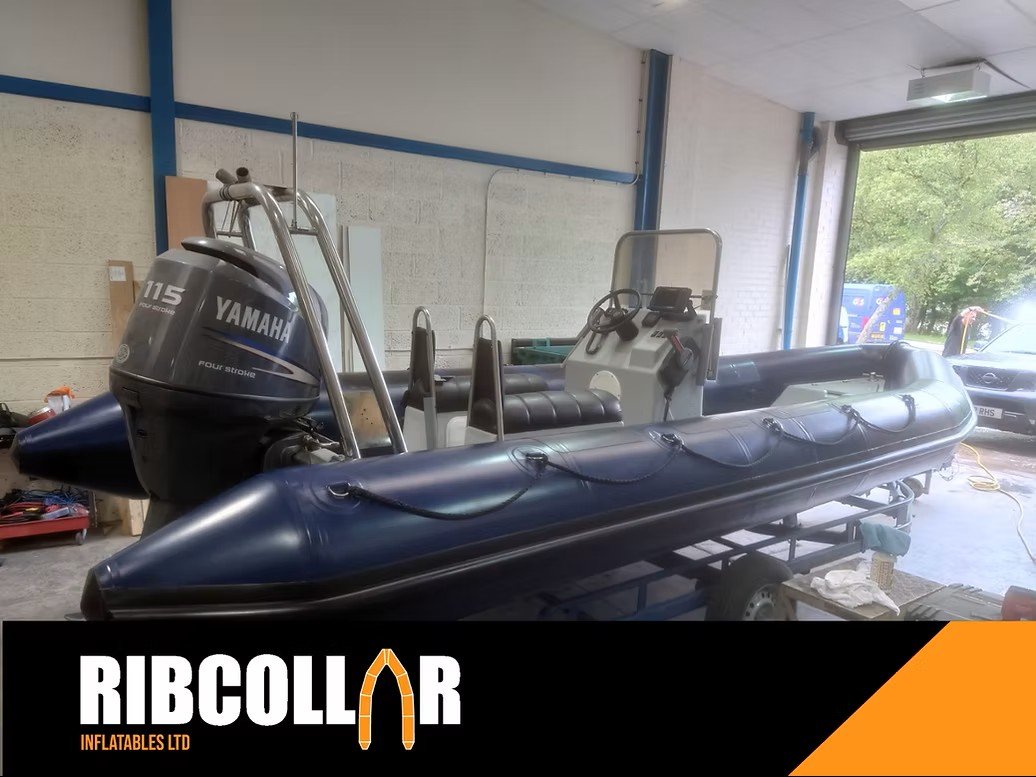
RIB Retubing and Tube Replacement: Complete Guide to Hypalon Tubes
RIB (Rigid Inflatable Boat) retubing is the process of replacing the inflatable tubes on a RIB, usually when the existing tubes are damaged or worn beyond sensible repair. Done properly, it can transform an older boat and give it a new lease of life, as long as the hull is still in good condition. Retubing is often a cost-effective alternative to buying a new boat when the hull is sound.
Q1. When to retube your Rigid Inflatable Boat
A1. Retubing is worth considering when:
- The tubes are punctured, leaking, or beyond practical repair.
- Older PVC and polyurethane tubes have aged to the point where reliable repairs are difficult. If they are leaking or damaged, retubing is often the only realistic option.
- Hypalon lasts longer, but over time the top layer can delaminate and the fabric becomes porous.
- You want to update an older RIB’s look and performance.
- The hull is in good condition, so the spend makes sense.
Q2. How do I retube my RIB (Rigid Inflatable Boat)
A2. Here is a more detailed look at the process.
1. Assessment and preparation
- Hull preparation
The existing tube is removed from the hull. Most RIB tubes are bonded to the hull, so removal is a slow process. The fabric is lifted by gently heating and pulling. - Template creation
If no existing template is available, the old tubes are removed and disassembled to create a new template, then scanned. - Fabric selection
We only use Orca Hypalon manufactured by Pennel. It offers long life and remains repairable 10 to 15 years down the line, unlike PVC or polyurethane. - Fabric inspection and cutting
The fabric is inspected, then Ribcollar cuts the new tube on CNC equipment.
2. Tube construction
- Seam preparation
Fabric edges are sanded, cleaned, and prepared. The surface is abraded to ensure the adhesive bonds correctly. This is done using manual sanding and a dedicated sanding machine. - Gluing
All joints are cold bonded. The main seam under the rubbing strake is also glued. We use Bostik 2402 for tube assembly. - Assembly
The tube is assembled by hand. Wooden circular formers are used to fit the internal baffles. The final stage is gluing the main seam before testing. - Components
Collars and tubes are fitted with Leafield inflation and pressure relief valves as standard. - Cleaning
Excess adhesive is removed and the tube is fully cleaned, ready for installation. - Pressure testing
The finished tube is pressure tested to confirm it is airtight.
3. Tube attachment
- Marking
The tube is marked to show its final position on the hull. - Gluing
The tube and hull are prepared and receive two coats of adhesive. - Bonding
The tube is bonded to the hull carefully, removing air bubbles as the work progresses.
4. Finishing
- Curing
The bond is left to cure. Tube assembly and installation should be done in a warm or heated environment with the right moisture controls. - Fitting out
Strakes, handles, and other hardware are fitted as required.
5. Additional services
- While the boat is being retubed, it is common to carry out other work such as hull repairs, engine servicing, and upholstery.
Key considerations
- Cost-effective: a full retube is often cheaper than buying a new RIB.
- Material: high-quality Hypalon is the standard choice for durability and repairability.
- Customisation: you can choose new colours, layouts, and features.
- Cost: varies by boat size, complexity, and fabric specification.
- Provider choice: use an experienced retubing shop with a proven process.
- DIY vs professional: some people buy a “tube in a box” and fit it themselves. Only do this if you have the skills and patience. Tube fitting is a learned trade.
- Timeframe: a full retube often takes a few weeks to a month, depending on workload and the boat.
Explore our RIB retube services to see how we replace damaged or ageing tubes.