
How to Retube a RIB: The Complete Guide to Hypalon Tube Replacement
Retubing a RIB means removing the old inflatable collar and bonding a new one to the same hull. The hull is reused, the tube is replaced, and a sound boat goes back into service for another twenty years or more.
The work runs in nine stages: assessment and patterning, tube removal, hull flange preparation, CNC fabric cutting, seam preparation, hand assembly, pressure testing, bonding to the hull, and curing with final fit-out. The sections below cover each stage, what drives the cost, and how to judge whether your boat is a retube candidate at all.
- Indicative cost
- From £1,200per running metre of tube, varying with specification
- Lead time
- 10–12 weeksshorter where we hold the pattern and can pre-manufacture
- Hypalon tube life
- 20+ yearswith reasonable care and storage in UK conditions
- Hull reused
- Yesa structurally sound hull is retubed, not replaced
Know your boat make, model and length? Send those with a few photos of the existing tubes and we will advise on scope and price.
Get a quote for a RIB retubeWhen to Retube Your RIB
Most owners consider a retube when the existing tubes are no longer reliable and repairs are either failing or no longer cost-effective. The key starting point is the hull: if the hull is structurally sound, a full retube is often a straightforward decision.
The most common reasons for a RIB retube are:
Air Leaks
Persistent slow leaks, particularly from seams or areas where the fabric has aged through.
Seam Failure
Bonded seams separating, particularly on older PVC and PU tubes where adhesive has degraded.
Delamination
The outer coating separating from the base fabric on Hypalon tubes, making the surface porous.
Fabric Porosity
Weave becoming exposed through the outer coating, allowing air permeation across large areas.
Failed Repairs
Multiple previous patches no longer holding, or the material no longer able to support adhesive bonding.
Physical Damage
Tube too badly torn, abraded or damaged for repair to be a reliable long-term fix.
UV Degradation
Severe sun damage reducing fabric strength to the point where the tube is a safety concern.
Refurbishment
Owner wants to update an older hull with a new collar, new colour and new fittings as part of a broader restoration.
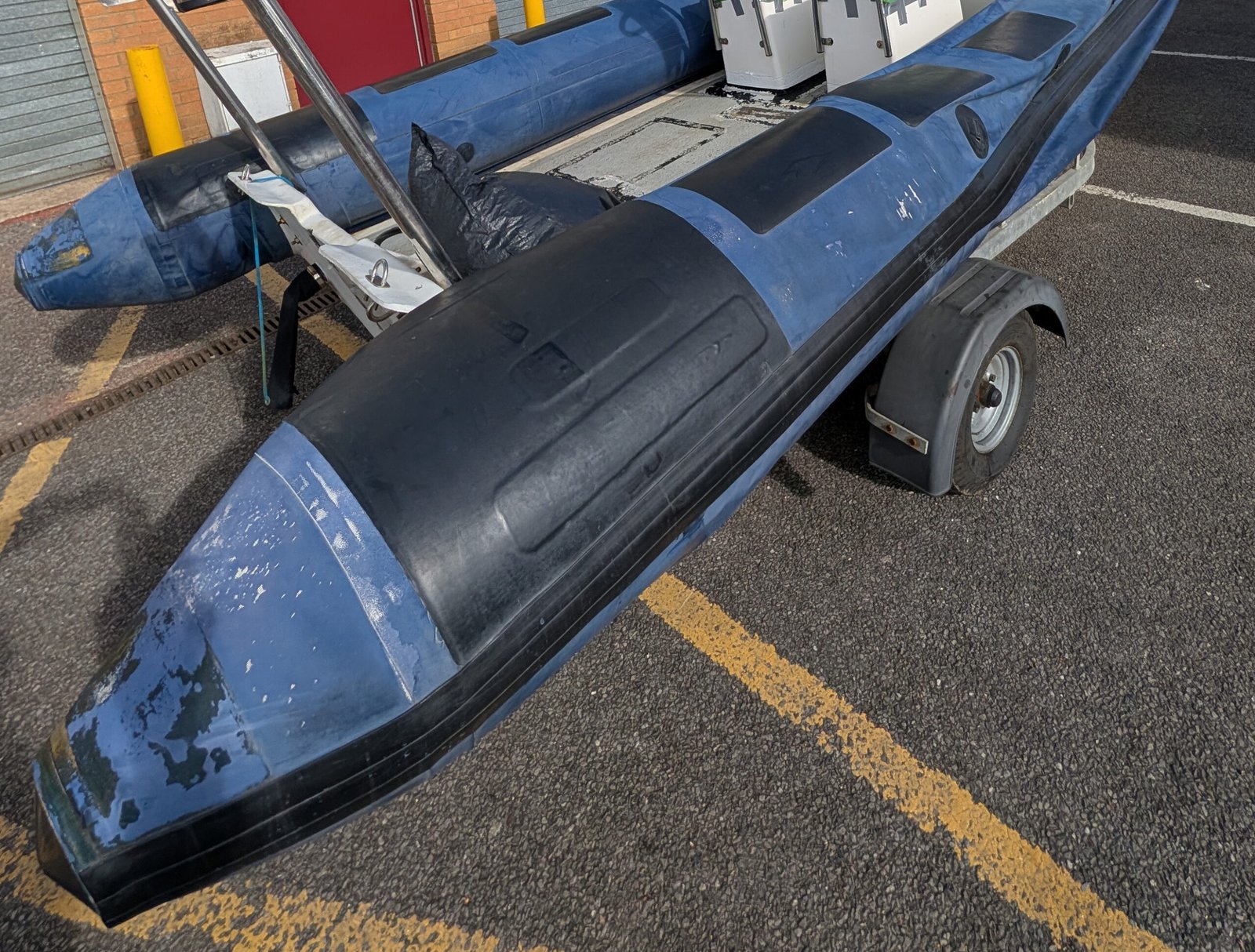
As a rough guide: Hypalon tubes on a well-maintained leisure boat typically last 20 years or more in the UK. PVC and PU tubes typically age faster, especially in high UV and salt environments, and are often more difficult to repair reliably as they get older.
Repair or Retube: How to Decide
This is the first question to answer before spending money. The right answer depends on the material type, the extent of the problem and the age of the fabric.
| Situation | Likely Route | Why |
|---|---|---|
| Single puncture, tube otherwise sound | Repair | Localised, clean problem on good material |
| Multiple patches already present | Consider retube | The tube is telling you it is reaching end of life |
| Seam failing on Hypalon tube | Repair or partial replacement | Hypalon seams are repairable if the fabric is still sound |
| Seam failing on old PVC or PU tube | Retube | Adhesive on aged PVC/PU rarely bonds reliably; more seams will follow |
| Outer coating delaminating or weave exposed | Retube | Material has lost structural integrity; repairs will not hold |
| Slow leak with no visible source | Assessment first | Source needs identifying before deciding. Fabric porosity across a large area points to retube. |
| UV damage reducing fabric strength | Retube | Structurally weakened fabric is a safety issue and cannot be repaired across the whole tube |
If you are not sure, send photos of the tube to Ribcollar with the boat make, model and length. We can usually advise on repair vs retube from photos before you commit to anything. See also: RIB Repairs.
Hull Assessment: the Starting Point
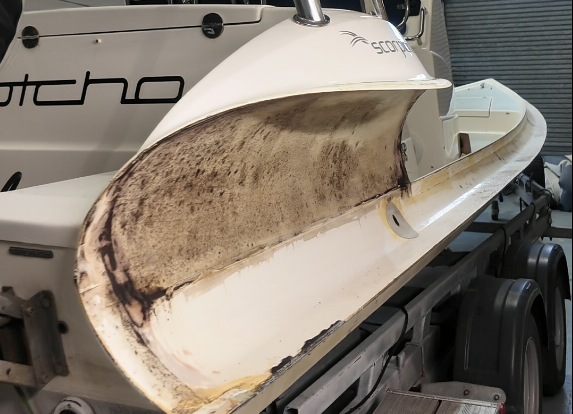
Before specifying a new tube, the hull needs to be assessed. A retube is only a sound investment if the hull itself is worth the spend.
The key checks are:
- Structural integrity of the GRP hull, with no major delamination, severe cracking or water ingress into the laminate
- Condition of the tube flange or hull bonding surface, which must be sound and cleanable
- Transom condition. If the transom is soft or showing water damage, that should be addressed before or alongside the retube
- Console, steering, electrics and engine condition. A sound hull with a worn-out mechanical fit-out may not justify a premium retube specification
At Ribcollar, we assess the hull as part of the initial review. Minor GRP repairs to the flange area can often be carried out as part of the retube job. More significant structural work is flagged before the tube is specified.
Practical Note
Hypalon tubes typically last 20 years or more on a well-maintained boat. A hull in good condition is worth retubing. A hull with structural problems is not a retube candidate until those problems are addressed, and in some cases the hull's condition makes a retube an uneconomic option.
Fabric Choice: Hypalon, PVC or PU
Three main materials are used for RIB tube manufacture. For replacement work and retubing, Hypalon (Orca CSM/CR) remains the preferred choice at Ribcollar and across most of the professional retube trade. The number one reason is repairability: a Hypalon tube stays repairable throughout its life, which is not the case with PVC or PU.
| Material | Construction | UV Resistance | Repairability | Typical Life |
|---|---|---|---|---|
| Hypalon (Orca CSM/CR) | Glued seams | Excellent, CSM compound | Very good, repairable at most workshops, even after many years | 20+ years |
| PVC | Welded or glued | Poor, no UV barrier in base material | Harder as material ages, adhesive less reliable on old PVC | 8–15 years |
| Polyurethane (PU) | Welded or glued | Good, better than PVC | Fewer workshops carry out PU repair, limited specialist availability | 10–20 years |
Ribcollar builds replacement tubes in Orca Hypalon, either Orca 828 (standard, up to ~7m) or Orca 866 (heavyweight, larger and commercial boats). The key reasons for this:
- Hypalon stays repairable by any competent workshop for the whole of its service life. Ageing PVC and PU often will not take a reliable bond, which turns a small repair into a retube
- The CSM compound gives reliable UV and weathering resistance for boats stored outside
- Colour and finish options are wider than any other material for retube work
- Orca fabric carries ISO 6185 and SOLAS ISO 15372 certification
For more on material choice, see: What material is your RIB tube made from? and Orca 828 vs 866 explained.
Ribcollar's Position
Ribcollar works exclusively in Hypalon, in both the manufacture and repair of RIB collars and tubes. We do not use PVC or PU. This is a deliberate decision based on long-term performance: Hypalon remains repairable by any competent workshop many years after fitting, which matters to the owners and operators who have to look after the boat for decades. It is also the number one choice for commercial operators, who need a fabric that is reliable, serviceable and does not let them down in service. For both of those reasons, Hypalon is our default fabric and the only material we use.
The RIB Retube Process, Step by Step
Initial Assessment and Specification
The boat comes in for assessment. We look at the hull condition, existing tube, attachment method and any flange damage. At this stage we also confirm the tube layout, material grade, colour, finishes and all fittings required for the job.
If the boat is already on file in our pattern database, we can work from existing templates. If not, we assess and pattern the hull before manufacture begins.
Tube Removal
The old tube is removed from the hull. Most RIB tubes are bonded to the hull flange, so removal requires heat and careful lifting to avoid damaging the GRP. The pace of this work is set by the hull condition. A well-bonded old tube on a clean hull takes longer than a tube that has already partially separated.
Hull Flange Preparation
With the old tube off, the hull bonding surface is cleaned and prepared. Old adhesive is removed. Any flange damage is repaired at this stage. The bonding surface needs to be clean, sound and properly keyed before the new tube goes on.
Fabric Cutting
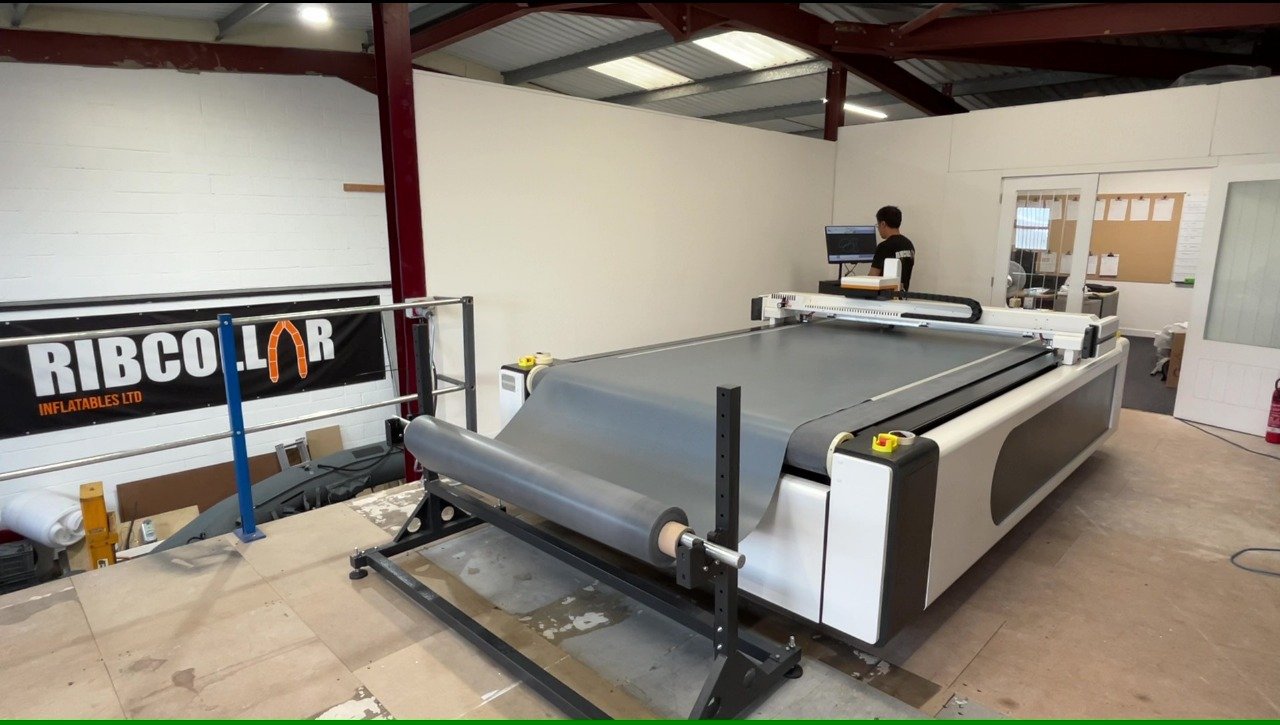
The Orca Hypalon fabric is inspected and laid out. At Ribcollar, tube panels are cut on CNC equipment to the pattern for the boat. CNC cutting gives consistent, accurate panel edges which are essential for the seam preparation and bonding stages that follow.
Seam Preparation
All seam edges are prepared by sanding (abrading) and cleaning before adhesive is applied. This is one of the most important stages in tube manufacture. Hypalon forms a mechanical bond, so the surface must be properly keyed and clean for the adhesive to work correctly. Skipping or rushing this stage is the main cause of seam failure on poorly built tubes.
Tube Assembly
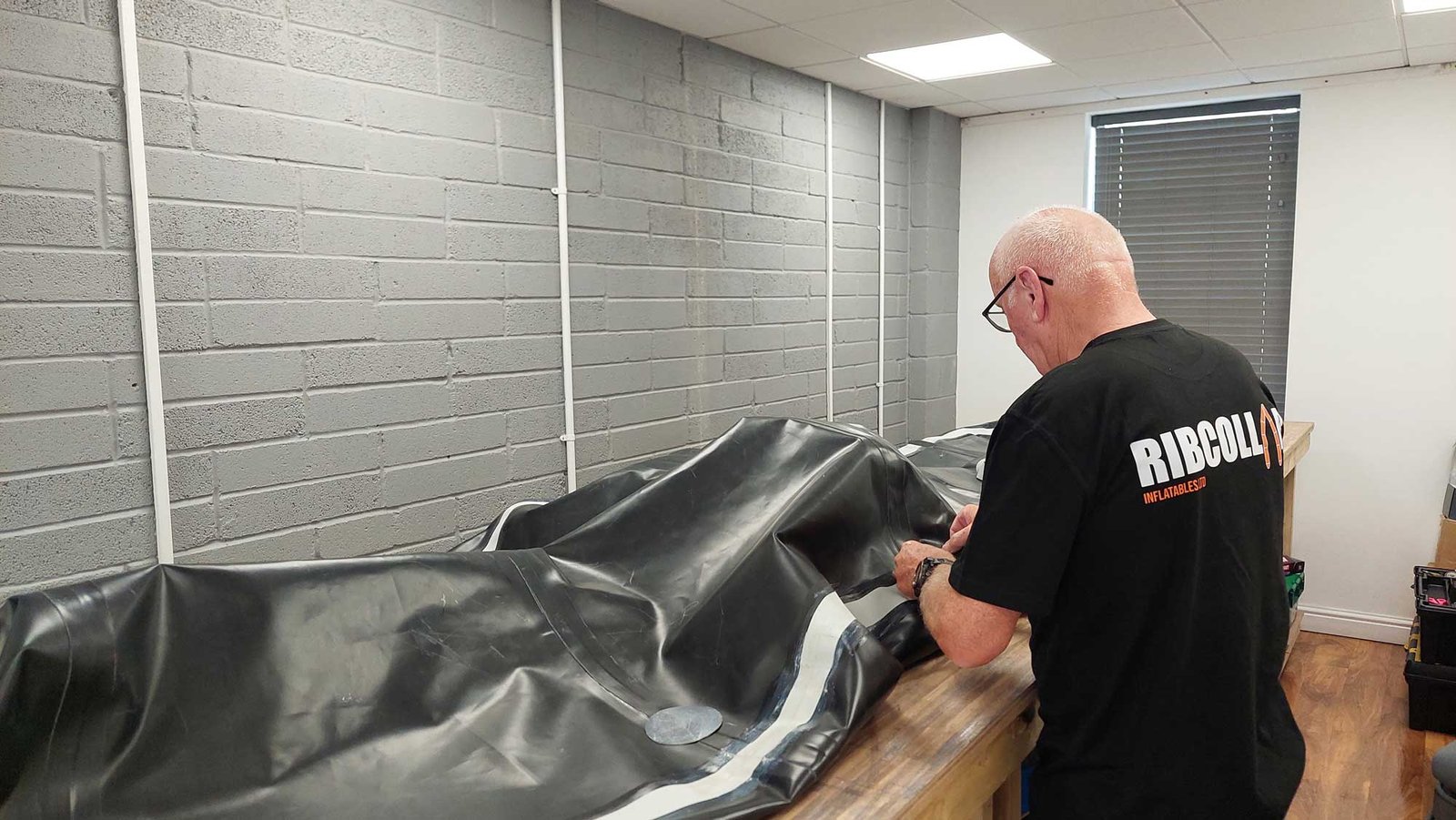
The tube is assembled by hand. All joints are cold bonded using Bostik NE486 adhesive, the industry standard for Hypalon tube construction. Wooden circular formers are used to maintain shape and fit internal baffles correctly. The main seam is glued last, before testing.
Leafield inflation valves and pressure relief valves are fitted as standard. Fittings including handles, lifelines, wear patches and rubbing strakes are bonded on as part of the assembly process.
Adhesive Note
Bostik NE486 and Bostik 2402 are basically the same stuff. NE486 is the upgraded version of 2402: both are solvent-borne polychloroprene formulations cured with Bostikure D curing agent, and Bostik's application instructions cover the two products together. The improvement is UV behaviour, the cured NE486 film having good resistance to UV exposure with reduced discolouration, which matters on a tube that spends its life outdoors.
Surfaces are cleaned with M501 cleaner, abraded, then cleaned again before adhesive is applied. Bond strength reaches maximum within 7 days of the 48-hour initial cure. NE486 also carries the UK Ministry of Defence quality assurance and release document AFS 1413.
Pressure Testing
The finished tube is pressure tested to confirm it is airtight before installation begins. This catches any seam issues before the tube goes onto the hull, when correcting problems is far more straightforward.
Tube Fitting
The new tube is marked to show its final position on the hull. Both the tube bonding face and the hull flange receive two coats of adhesive. The tube is then carefully bonded down, working progressively to remove air bubbles and ensure consistent contact along the full flange area.
Assembly and bonding must be done in a warm or heated environment with appropriate moisture control. Temperature and humidity affect adhesive performance and curing time.
Curing and Final Fit-out
The bond is left to cure fully. Once cured, any additional strakes, hardware and finishing details are fitted. The boat is cleaned down, given a final check and made ready for handover.
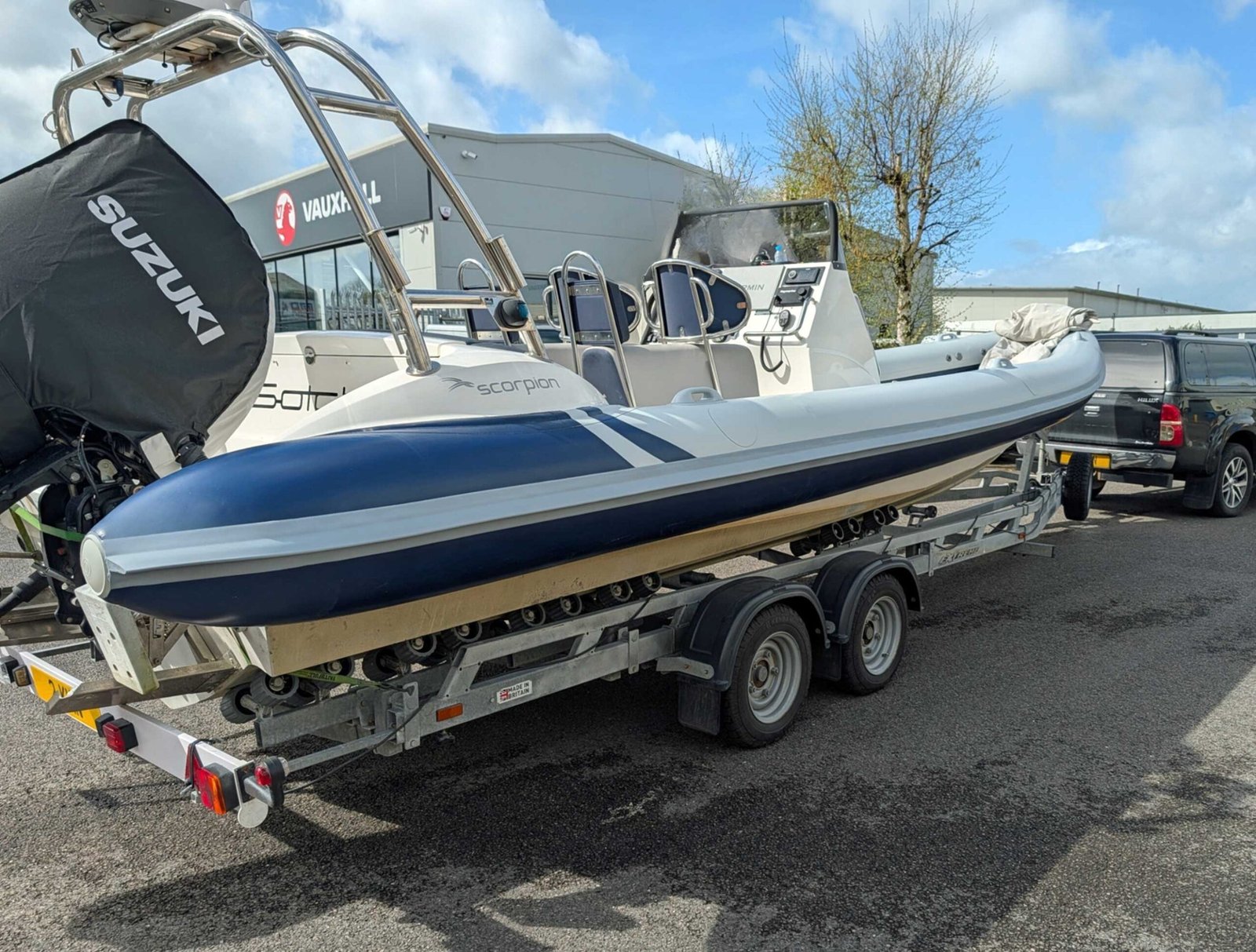
Outside the UK? We ship made to measure tube sets worldwide through Tube in a Box.
Fittings and Finish Options
A retube is the best opportunity to specify the protection, layout and fittings that suit the way the boat is used. Standard fit-out on a Ribcollar retube includes Leafield inflation and pressure relief valves, four handles, lifelines and wear patches.
Beyond that, the specification can be adjusted to suit the boat and its application:
Rubbing Strips & Strakes
Standard protection for the tube where it regularly contacts pontoons, quays or other vessels. Available in various profiles.
Cladding
Heavier-duty wear protection up to 3mm for large-area contact zones. Common on military, police and commercial working boats.
Wear Patches
Bonded reinforcement in high-contact areas: boarding points, stern areas and any section seeing regular foot or rope contact.
Handles & Lifelines
Number and position adjusted to suit the boat's use. Commercial and rescue boats typically have more handles at specific positions.
Fairleads & Bow Fittings
Snubbers, fairleads and bow patches for anchor and towing lines. Extra reinforcement around high-load points.
Custom Tube Markings
Boat names, numbers and identification markings. Common on commercial, rescue and patrol craft.
DIY vs Professional Retube
"Tube in a box" kits are available from some suppliers for owners who want to self-fit. The tube is supplied pre-built and the owner glues it to the hull themselves. This is a legitimate option for some owners but the decision should be made clearly.
| DIY fitting | Professional retube | |
|---|---|---|
| Cost | Tube supply only. Lower upfront, but no allowance for putting a failed bond right | Supply and fit, from around £1,200 per running metre depending on specification |
| Time | Your own pace. Allow several full days for removal, flange cleaning and bonding | 10–12 weeks lead time, shorter where we hold the pattern. Boat with us for the fitting stage |
| Tools and facilities | Heat source, abrasives, solvent cleaner, rollers, and a warm dry space with humidity control | CNC cutting, pattern database, temperature and humidity controlled workshop |
| Main risk | Hull flange preparation and adhesive technique. Both are the usual cause of a failed bond | Carried by us. Tube is pressure tested before it goes near the hull |
| Warranty | Fabric only, if the supplier offers one. Nothing on the fitting | Warranty on tube and workmanship |
| Suits | Experienced owners who have bonded Hypalon before | Most owners, and any commercial, rescue or military boat |
Professional Retube: Advantages
- Hull assessment and flange preparation included
- CNC-cut panels with accurate seam tolerances
- Correct adhesive application and environment control
- Pressure tested before fitting
- Fittings specified for the actual application
- Warranty on the workmanship
Professional Retube: Considerations
- Higher cost than DIY supply-only options
- Lead time, typically 10–12 weeks
DIY Fitting: Advantages
- Lower upfront cost
- Can be done at your own pace
- Suitable for experienced owners who understand the process
DIY Fitting: Risks
- Hull flange preparation is the most common failure point
- Adhesive requires correct technique, temperature and moisture control
- No warranty on fitting if you do it yourself
- Getting it wrong is expensive, and the tube may need redoing professionally
- Tube fitting is a learned trade; watching videos is not the same thing
Our View
DIY fitting is possible for an experienced, patient owner with the right tools, working environment and preparation. For most owners, the cost difference does not justify the risk of a poor fit. A badly bonded tube is at best an inconvenience and at worst a safety issue. If you are not confident, use a professional shop.
How Much Does a RIB Retube Cost?
As a starting point, work on around £1,200 per running metre of tube. That puts a 6.0m RIB in the region of £7,000 for a straightforward retube in Orca Hypalon. The figure moves with specification rather than with fabric choice, because we build in Hypalon only.
| Boat length | Indicative retube, from | Notes |
|---|---|---|
| 4.0m | From £5,195 | Simple single-tube collar, standard fit-out |
| 4.5m | From £5,195 | Standard leisure specification |
| 5.0m | From £5,775 | Standard leisure specification |
| 5.5m | From £6,995 | Wear patches and strakes usually worth specifying |
| 6.0m | From £6,995 | Around the most common size retubed |
| 6.5m | From £7,895 | Often a commercial or harder-worked boat |
| 7.0m | From £8,795 | Multi-tube or shaped collars common at this size |
| 7.5m | From £10,990 | Layout and fit-out vary most at this size. Larger boats quoted individually |
Treat these as a starting point for budgeting, not a quote. Two boats of the same length can differ considerably once cladding, wear patches, colour flashes, extra handles and custom markings are specified. What moves the price is the extras, not the fabric.
What affects the figure:
Boat Length
More fabric, more labour, more fittings. The single biggest driver of retube cost.
Fabric Grade
Orca 866 costs more per metre than Orca 828. Grade is determined by boat size and use.
Tube Layout Complexity
Multi-tube assemblies, shaped bows and complex collar designs take longer to build.
Fittings Specification
Cladding, strakes, handles, bow protection and custom markings all add to cost.
Hull Flange Condition
Significant flange repair or preparation work adds time and therefore cost to the job.
Pattern Availability
Boats already on file are quicker and cheaper to process than boats requiring new patterns.
The most useful way to understand what your retube will cost is to send us the boat make, model, length and photos. We will provide a written quote based on the actual job rather than a bracket. Contact us at sales@ribcollar.com or call 01935 722988.
A RIB retube is regularly compared against the cost of buying a replacement boat. For a sound hull, a retube at a fraction of new-boat cost is often the better financial decision, particularly where the hull is a well-regarded model that retains value.
How Long Does a RIB Retube Take?
Typical lead time is 10 to 12 weeks. Where we already hold the pattern for the boat, the tube can be manufactured ahead of the boat arriving, which cuts the time the boat is off the water considerably.
| Factor | Effect on Lead Time |
|---|---|
| Pattern already on file | Tube can be pre-manufactured before the boat arrives, cutting time off the water |
| New pattern required | Adds time for assessment and pattern creation |
| Simple tube layout | Faster build |
| Complex collar geometry or multi-tube assembly | Longer build time |
| Hull flange in good condition | Straightforward prep and fit |
| Hull flange repairs required | Adds time for flange work before fitting can start |
| Current workshop schedule | Contact us to confirm current lead times before booking |
The winter months are typically quieter than the spring run-up season. If you are planning a retube ahead of the season, booking early avoids the March–April bottleneck that most retube shops see every year.
Frequently Asked Questions on RIB Retubing
Is a RIB retube worth it?
If the hull is structurally sound, yes, in most cases. A retube costs a fraction of a replacement boat and gives the hull another 20 years or more of service life if the new tubes are Hypalon and the specification is right. The calculation is straightforward: if the hull is worth more than the retube cost, it is worth doing.
Can I retube my own RIB?
You can buy a tube as a supply-only item and fit it yourself. Whether you should depends on your skills, tools and patience. Hull flange preparation and adhesive application are the steps most likely to go wrong for a first-timer. A poorly bonded tube is dangerous on the water. If you are not experienced with Hypalon bonding work, use a professional.
What glue is used to retube a RIB?
Bostik NE486 is the industry-standard adhesive for Hypalon RIB tube construction and bonding. It is a contact adhesive applied in two coats to both surfaces before the bond is made. Temperature and surface preparation both significantly affect adhesive performance. Do not attempt to use standard contact adhesives as substitutes for the correct professional product.
How long does a RIB retube last?
A Hypalon retube on a well-maintained leisure boat typically lasts 20 years or more in UK conditions. This assumes proper storage, reasonable use and no significant physical damage. Commercial and harder-worked boats will see shorter tube life depending on the intensity of use. PVC and PU replacement tubes typically have shorter service lives than Hypalon equivalents.
Can you retube any make of RIB?
Yes. Ribcollar can retube all makes and models of RIB that can be delivered to our Yeovil workshop. We hold patterns for many common makes and models. Where a pattern is not already on file, we assess and pattern the hull before manufacture begins. Makes we regularly retube include Ribcraft, Avon, Humber, Tornado, AB, Zodiac, Gemini, Valiant and others.
What is the difference between a retube and a collar replacement?
The terms are used interchangeably in most contexts. A collar or tube is the inflatable part of the rigid inflatable boat. A retube means replacing the complete inflatable collar or tube system with new fabric. Some boats have multiple inflatable sections, referred to as tubes, sponsons or collars depending on the manufacturer. The process is the same regardless of terminology.
Do you need to see the boat before quoting?
Not always. For boats already on file in our pattern database, we can often quote from the boat make, model, length and a brief condition description. For boats not on file, or where the hull condition is uncertain, we will ask for photos before quoting. If the hull has significant flange damage or structural issues that need assessing in person, we will say so before you commit to bringing the boat in.
Ready to get a quote for your retube?
Send us the boat make, model, length and photos of the existing tubes. We will confirm scope, provide a written quote and advise on material grade, colour and fittings for the job.