
What Material Is Your RIB Tube Made From?
Most RIB tubes are made from Hypalon, PVC or polyurethane. Each behaves differently in service, ages differently and responds differently to repair. Identifying the material correctly is the first step before deciding whether to repair or replace.
- Preferred grade
- Hypalon
- Volume production
- PVC
- Specialist grade
- PU
CSM-based fabric. Strong UV resistance, long service life, best repairability. The preferred material for quality leisure, commercial and rescue RIBs.
Widely used, lower cost, suits production builds. Heat-welded seams. Does not usually match Hypalon for long-term ageing under UV and hard use.
Polyurethane. Used on some commercial and military applications. Tougher and stiffer than both Hypalon and PVC. Harder to repair once badly damaged.
Three quick checks will usually tell you what your tubes are made from: the seam, a cut or worn edge, and the surface around the valve.
Glued seams, a matt finish and fine dark dust on a rubbed edge point to Hypalon. Welded seams and a gloss surface point to PVC or polyurethane. No single check is conclusive, so use them together. The three checks are set out lower down this page, graded by how much handling each one involves.
What each material means in practice.
Identifying the material correctly helps you avoid spending money on a repair that is unlikely to last, and gives you a better basis for deciding whether to repair or replace.
Tube material affects service life, repairability, finish and long-term value. It also determines which adhesives, preparation methods and repair techniques are suitable.
For that reason, material identification is an important part of any tube assessment, whether we are reviewing photos, inspecting the boat in person or advising you on the options before work begins.
Hypalon, PVC and PU: what each one is.
Hypalon
Often referred to as CSM-based fabric. Widely regarded as the preferred material for long-term durability. Bonded with adhesive rather than heat welded, which makes it a strong material for repair and retube work.
The original DuPont Hypalon brand was discontinued in 2010. Orca by Pennel & Flipo is the industry-standard equivalent used by Ribcollar and most professional retube workshops.
- Matt, rubber-like surface finish
- Dark grey or black inner surface in many cases
- Glued seams rather than welded seams
- Fine dust when lightly abraded on the surface
- Slight flexibility and memory when bent
PVC
Widely used because it is lower in cost and suits volume production. Often has a smoother, glossier finish and is heat welded rather than adhesive bonded. Does not usually offer the same long-term ageing performance as Hypalon under UV.
PVC becomes brittle as it ages and the plasticisers that give it flexibility leach out over time. Older PVC tubes can be difficult or impossible to repair reliably with adhesive.
- Shiny or semi-gloss surface finish
- Smooth, plastic-like feel
- Welded seams with a visible raised ridge
- Stiffer in cold temperatures
- May show chalking or fading under heavy UV
Polyurethane (PU)
Used on some commercial, military and higher-specification leisure builds. Tougher and more abrasion-resistant than PVC in many applications. Better UV resistance than PVC but harder to repair once damage is significant.
PU tubes require specialist materials and techniques for repair. Fewer workshops are set up to carry out PU repair reliably. If a PU tube is reaching end of life, replacement rather than repair is usually the more practical route.
- Satin or semi-gloss finish, smoother than Hypalon
- Heavier and stiffer feel than Hypalon
- Welded seams in most cases
- More resistant to surface scratching than Hypalon
- Less common than PVC on UK leisure boats
Hypalon, PVC and PU side by side.
| Property | Hypalon (CSM/CR) | PVC | Polyurethane (PU) |
|---|---|---|---|
| UV resistance | Excellent | Poor | Good |
| Seam type | Adhesive bonded | Heat welded | Welded or bonded |
| Repairability | Very good | Harder as material ages | Limited, specialist only |
| Cold flexibility | Good | Stiffens significantly | Moderate |
| Abrasion resistance | Good | Good | Very good |
| Service life (typical) | 20+ years | 8–15 years | 10–20 years |
| Cost | Higher | Lower | Mid to higher |
| Common marques | Ribcraft, Humber, Ribtec, Scorpion, Avon, Ballistic, Cobra, Redbay, Osprey, Ring | Bombard, Honwave, Tohatsu, Quicksilver, Zodiac leisure, Narwhal | Tornado, Valiant commercial, Vanguard, XS Ribs |
| Retube suitability | Preferred choice | Rarely recommended | Possible, but limited |
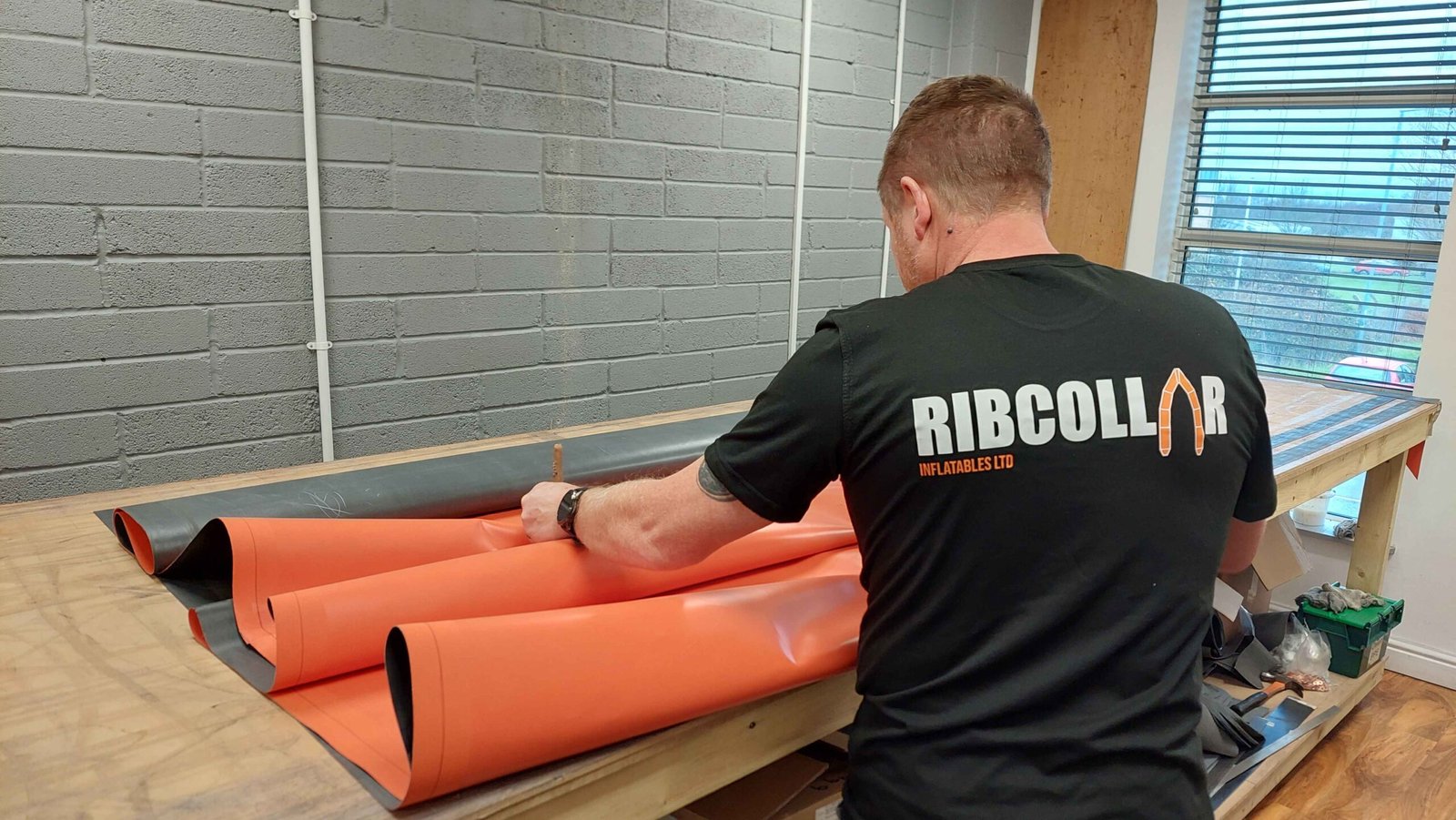
Ribcollar's position
Ribcollar works exclusively in Orca Hypalon for all retube, new tube and repair work. We do not use PVC or PU. The number one reason is repairability: a Hypalon tube stays repairable throughout its service life, so a twenty-year-old tube with a puncture is usually a repair job. Ageing PVC and PU often will not take a reliable bond, which turns the same puncture into a replacement. If your tubes are PVC or PU we will say so and point you elsewhere rather than take on work we cannot stand behind. See Hypalon repairs and retubing.
How to identify the material on your boat.
If you are still unsure after these checks, send photos to Ribcollar with the boat make, model and year. We can usually advise on the material from good quality photos of the tube surface, seams and inner surface.
The easiest route is to ask the manufacturer. Give them the boat model, year and hull identification number and they will normally tell you what the tubes were originally built in. Failing that, or where the boat has already been retubed, you can narrow it down yourself with a combination of visual checks and simple tests. No specialist equipment is needed for the first of them.
Work through them in order. Each one involves more handling than the last, so stop at the point you are comfortable with and send us photos rather than pushing further.
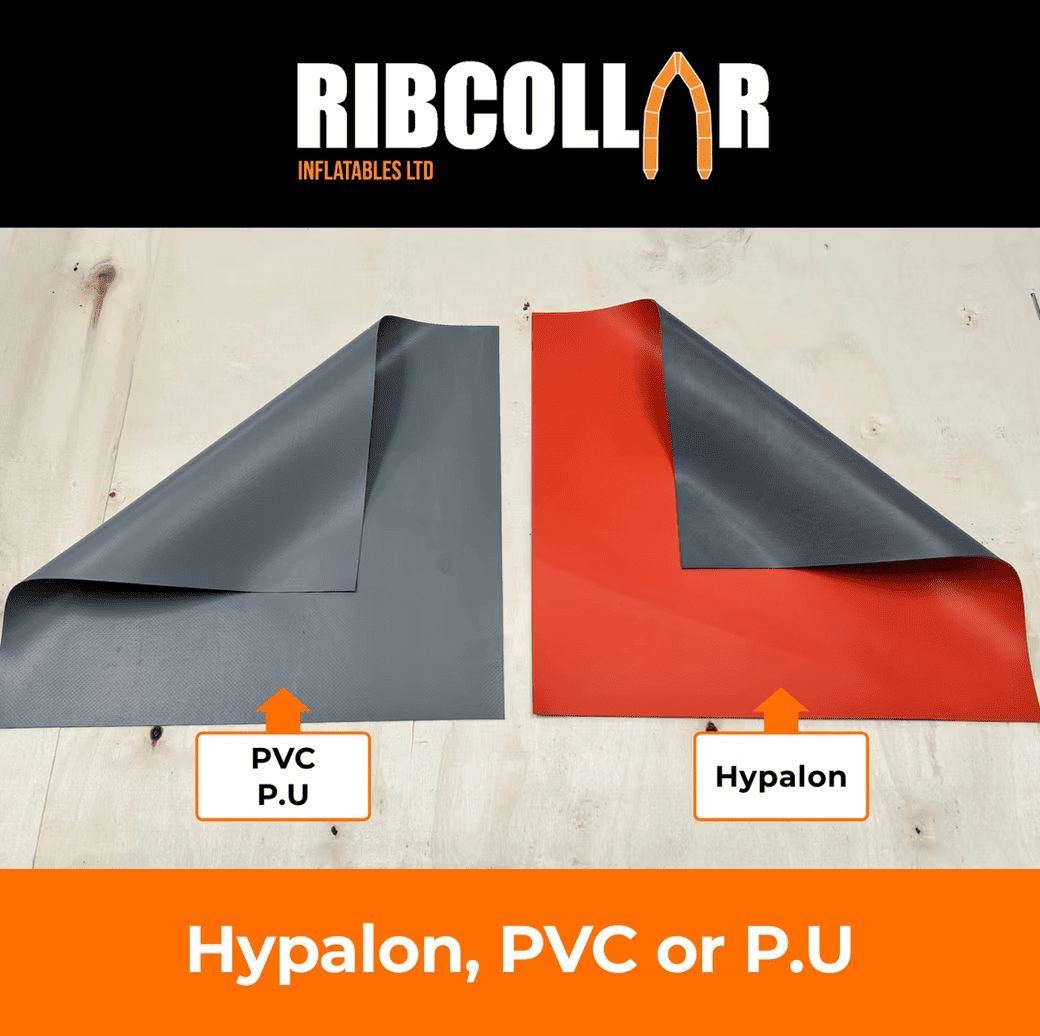
Seams and surface finish
Glued seams with visible tape or a folded join usually indicate Hypalon. Welded seams with a smooth raised ridge usually indicate PVC or PU. This is the single most reliable quick indicator.
Surface finish backs it up. Matt and rubber-like is likely Hypalon, shiny or semi-gloss likely PVC, satin with a heavier feel possibly PU. Some PVC tubes have lower-sheen finishes that look similar to Hypalon at first glance, so do not judge on finish alone.
The edge and valve checks
Find a cut edge, a worn patch or a trimmed end near a fitting. Hypalon shows a fabric weave sandwiched between two rubber coatings. PVC and PU show a more homogenous section with the coating fused to the cloth. Rub firmly with a fingernail: aged Hypalon gives up fine dark dust, PVC marks or glosses instead.
The inner surface is another indicator, seen through the valve housing. Hypalon is usually dark grey or black inside, PVC often lighter, cream or pale grey.
Only unscrew a valve insert if you know what you are doing. On some valves the back of the housing can come loose and drop inside the tube, which then needs the tube opening up to retrieve it. If in doubt, leave the valve alone and send us photos instead.
The solvent test
On an inconspicuous spot, dab a little MEK or acetone on a cloth and press it to the surface for a few seconds. PVC softens and the cloth picks up colour or gloss. Hypalon is largely unaffected.
Use this one last and sparingly. It is the most definitive of the three and the only one that alters the surface, so keep it away from seams and anywhere you might later want to bond.
Still not certain? Send photos of the tube surface, a seam and a cut edge with the boat make, model and year. We identify the material from photos most days.
Ask Ribcollar to identify your tubeMarque lookup: which builders used which fabric.
This is a guide, not identification. Tube material varies by model, year and original customer specification, and manufacturers have changed material between production runs. Use it to narrow things down, then confirm with the three checks above.
| Marque | Typical original fabric | Notes |
|---|---|---|
| Ribcraft | Hypalon / CSM | Predominantly Hypalon. Strong commercial and rescue market |
| Humber | Hypalon / CSM | Orca Hypalon used across the current RIB range |
| Ribtec | Hypalon / CSM | Traditionally Hypalon |
| Scorpion | Hypalon / CSM | Predominantly Hypalon |
| Revenger | Hypalon / CSM | Predominantly Hypalon |
| Redbay | Hypalon / CSM | Predominantly Hypalon |
| Osprey | Hypalon / CSM | Predominantly Hypalon |
| Ballistic | Hypalon / CSM | Predominantly Hypalon |
| Cobra | Hypalon / CSM | Predominantly Hypalon |
| Ring | Hypalon / CSM | Predominantly Hypalon |
| Ribquest | Hypalon / CSM | Predominantly Hypalon |
| Rib-X | Hypalon / CSM | Predominantly Hypalon |
| Avon | Hypalon / CSM | Older Avon boats are a particularly strong Hypalon retube and repair market |
| Williams Jet Tenders | Hypalon / CSM | Generally Hypalon |
| Lomac | Hypalon / CSM | Predominantly Hypalon |
| Nuova Jolly | Hypalon / CSM | Predominantly Hypalon |
| Novurania | Hypalon / CSM | Predominantly Hypalon |
| Stingher | Hypalon / CSM | Predominantly Hypalon |
| Sillinger | Hypalon / CSM | Strong professional and military orientation |
| Zodiac Hurricane | Hypalon / CSM or specialist fabrics | Professional and military craft. Check the individual specification |
| Ribeye | Mixed | Smaller and Playtime boats often PVC. Larger boats and newer A/S ranges generally Hypalon |
| BRIG | Mixed, increasingly Hypalon | Earlier and specification-dependent boats include PVC. Orca Hypalon used across much of the range |
| Highfield | PVC or Orca Hypalon | Both offered depending on model and specification. Aluminium hulls |
| Zodiac | Mainly PVC, Hypalon on some | Leisure boats commonly PVC or Strongan. Professional, military and some specified boats use Hypalon |
| Yamaha / YAM | Mixed | YAM inflatable tenders commonly PVC. YAM RIBs have commonly used Hypalon |
| Gemini | Mixed | RIB and commercial specifications need checking. Smaller tenders often PVC |
| Vanguard | PVC / PU / Hypalon | Specification dependent, with PU particularly associated with larger commercial boats |
| XS Ribs | PU / Hypalon | Both have been used |
| Valiant | PVC / PU | Smaller and leisure boats commonly PVC. Some larger commercial boats use PU |
| Tornado | PU | One of the best-known users of polyurethane. Some older boats were Hypalon |
| Narwhal | PVC / PU | Predominantly PVC, with PU versions |
| Quicksilver | Mainly PVC | Some Hypalon versions exist |
| Bombard | PVC | Predominantly PVC |
| Honda / Honwave | PVC | Predominantly PVC |
| Tohatsu | PVC | Predominantly PVC |
Never rely on the marque alone. Manufacturers changed materials between models and production years, and commercial or military boats are frequently built to customer-specific requirements. Where the material matters, confirm it from the model and year, the hull identification number, the original specification, clear photographs of the fabric and seams, and the reverse of the fabric where you can get at it.
An ageing PVC or PU collar can still be replaced with a new Orca Hypalon collar. That is a retube rather than a repair, and it is work we do regularly. See RIB retubing or new Hypalon tubes.
What the material means for repair and retube decisions.
A Hypalon tube can often be repaired reliably years after manufacture. A heavily aged PVC tube frequently cannot, because the adhesive simply will not bond to the degraded surface. Knowing the material before you spend money on a repair matters.
The material is one of the key factors in deciding whether a repair is worth attempting or whether replacement is the more sensible route.
Hypalon
Good repair candidates in most cases, provided the base fabric is still sound. Hypalon bonds well with professional adhesive even on older material, so localised damage such as punctures, small seam failures and valve replacements can often be addressed reliably.
Where damage is extensive or the outer coating has degraded significantly, a retube is usually the better investment. But material condition alone does not rule out repair on Hypalon the way it often does on aged PVC.
PVC
Repair success depends heavily on the age and condition of the material. Newer PVC in good condition can be patched, but as PVC ages and the surface degrades, adhesive bonding becomes increasingly unreliable.
On older PVC tubes showing UV damage, chalking or surface brittleness, a repair patch is unlikely to hold long-term. In these cases, the practical options are either living with the limitation or replacing the tube with Hypalon at retube.
Polyurethane (PU)
PU requires specialist repair materials and techniques. Not all workshops are equipped to carry out PU repair reliably. Where a PU tube has significant damage or has reached end of life, replacement is usually the most straightforward option.
For replacement, most owners of PU-tubed boats opt to retube in Hypalon rather than like-for-like, given the wider repair availability and longer service life that Hypalon offers.
Not sure which route is right?
Send us photos of the tube with the boat make, model, length and a description of the problem. We will advise whether repair or retube makes more sense for your situation, including whether the existing material is worth working on. See also: How to Retube a RIB: Complete Guide.
Common questions on RIB tube materials.
How do I know if my RIB tube is Hypalon or PVC?
The most reliable quick indicator is the seam. Hypalon tubes are adhesive bonded with visible glued seams. PVC tubes are heat welded with a smooth raised seam ridge. Surface finish is a secondary indicator. Hypalon is matt and rubber-like, PVC is typically glossier. If still unsure, send photos and we will advise.
Is Hypalon better than PVC for RIB tubes?
For long-term durability, repairability and UV resistance, yes. Hypalon outperforms PVC in all three areas over a typical boat ownership period. PVC is lower in cost and suits high-volume production builds, but it does not age as well under UV and becomes progressively harder to repair reliably as it gets older. For any serious retube investment, Hypalon is the right material.
Can you repair a PVC RIB tube?
Sometimes, depending on the condition of the material. Newer PVC in good condition can often be patched. Older PVC with UV damage or surface degradation is a different matter. Adhesive frequently will not bond reliably to degraded PVC, which means a repair patch is unlikely to hold. If the tube is significantly aged, the more practical decision is often to retube in Hypalon rather than spend money on a repair that may not last.
Can you repair a PU RIB tube?
PU repair is possible but requires specialist materials and expertise. Not all retube workshops carry out PU repair reliably. If a PU tube has reached end of life or has significant damage, replacement is usually the more practical route. Most owners in this position opt to retube in Hypalon for the wider repair availability and service life it offers.
Is Orca still real Hypalon? DuPont stopped making it.
DuPont discontinued the original Hypalon brand in 2010, but the material itself, CSM-based chlorosulfonated polyethylene fabric, continued to be manufactured. Orca, made by Pennel & Flipo in Belgium, is the industry-standard successor and is what the RIB trade refers to as Hypalon. It uses the same CSM/CR compound construction as the original and is the fabric Ribcollar uses across all work.
My boat has PVC tubes. Should I retube in Hypalon?
If the hull is sound and you are investing in a retube, specifying Hypalon is the sensible long-term decision. The cost difference is meaningful but the performance and service life difference is more so. A Hypalon retube on a sound hull should give you 20 years or more of reliable service with better repair options throughout. That is a significantly better return than a like-for-like PVC replacement in most cases.
What adhesive is used to repair Hypalon tubes?
Ribcollar uses Bostik NE486 for Hypalon tube construction and repair work. It is a professional-grade contact adhesive specifically formulated for CSM-based fabrics. It contains toluene and is not for public sale under UK REACH regulations. It is a trade product used by workshops and professional fabricators. Do not attempt to use general-purpose contact adhesives as a substitute on Hypalon tube work.
Not sure what material your tubes are made from?
Send us photos of the tube surface, seams and any damage. We will identify the material and advise on whether repair or retube is the right route for your boat.