
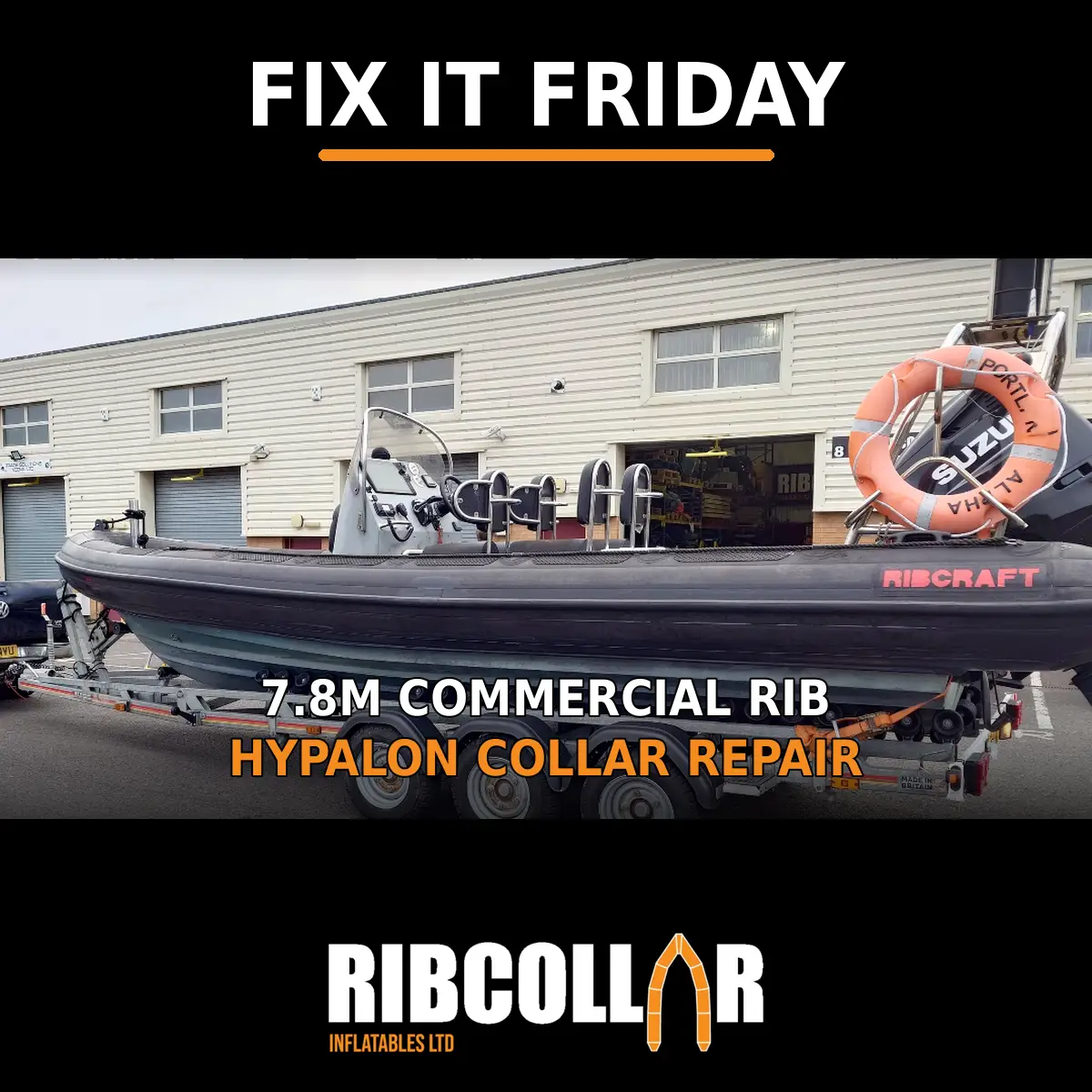
This week’s Fix It Friday features a commercial RIB collar repair on a 7.8 metre rigid inflatable boat. The operator brought the boat to our Yeovil factory for a series of targeted repairs to the Hypalon collar, attachment areas and external fittings.
The work included stripping back sections of the tube cover, removing and renewing attachment strips, repairing the external cladding, repairing a grab handle and addressing damaged sections of rubbing strake.
Completing these repairs together allowed the operator to deal with several areas of wear during one workshop visit. This is often more practical than treating each defect separately as it develops.
What the RIB collar repair included
The collar had several areas requiring attention rather than one isolated puncture or leak. Our technicians assessed the visible damage before stripping back the affected sections and preparing them for repair.
The work comprised:
- Stripping back sections of the tube cover
- Removing worn attachment strips
- Preparing and fitting replacement attachment strips
- Repairing damaged external cladding
- Repairing a grab handle
- Repairing sections of rubbing strake
- Completing additional localised collar repairs
Each part of the collar performs a different job. Attachment strips secure the tube or cover to the boat. Cladding protects areas exposed to repeated contact and abrasion. Handles provide secure handholds for crew and passengers. The rubbing strake protects the collar during berthing, boarding and normal commercial operation.
Damage to these components does not always mean the complete collar requires replacement. A detailed assessment helps establish whether a targeted RIB repair remains a sensible option.
Why attachment strip repairs require proper preparation
Attachment strips and bonded fittings rely on correctly prepared surfaces. Applying material over damaged adhesive, contamination or poorly prepared fabric is unlikely to provide a satisfactory long-term result.
For this repair, the relevant sections of the tube cover were stripped back to expose the areas requiring work. The worn strips were then removed before the surfaces were prepared for the replacement material.
This stage takes time, but it forms an important part of the repair. The condition beneath a fitting or cover is not always clear until the area has been opened and inspected.
Our RIB repair guide explains some of the common types of tube and collar damage, including patches, seams, valves, handles and rubbing strakes.
Repairing cladding, handles and rubbing strake
Commercial boats often experience concentrated wear in predictable areas. Boarding points, working positions, berthing areas and sections close to equipment tend to receive more contact than the rest of the collar.
Cladding and wear patches provide additional protection in these areas. Once damaged, they should be assessed before wear transfers into the main collar fabric beneath them.
Handles also need to remain securely attached. A loose or damaged handle places extra strain on the surrounding material and should not be ignored, particularly on boats used by crews, passengers or rescue personnel.
Rubbing strake damage is another common issue on working RIBs. The strake absorbs contact during normal use, but localised damage or lifting sections should be repaired before a larger section becomes affected.
Commercial RIB collar repair and planned maintenance
A commercial RIB collar repair is often most effective when it forms part of planned maintenance rather than an emergency response to a major failure.
Operators should inspect the collar regularly for:
- Loose edges around handles and fittings
- Lifting or damaged rubbing strake
- Abrasion through cladding or wear patches
- Changes around seams and attachment points
- Slow pressure loss
- Previous repairs beginning to lift
- Damage caused by fuel, equipment or repeated contact
Early inspection gives the repairer a clearer view of the available options. It also helps the operator plan the work around vessel availability.
Photos are useful for an initial review, although some faults require a workshop inspection before the full scope becomes clear.
When does a RIB need a complete retube?
Not every damaged collar remains suitable for repair. The decision depends on the condition of the main fabric, seams, internal baffles, attachment system and the number of defects across the collar.
A small number of localised repairs might remain commercially sensible. A collar with widespread fabric deterioration, recurring seam failure or extensive previous repairs might be better suited to complete RIB retubing.
The boat’s age alone does not decide the answer. Its material, storage, operating conditions, maintenance history and previous repairs all affect the assessment.
Ribcollar repairs Hypalon collars fitted to all makes of rigid inflatable boat. We also manufacture complete replacement Hypalon collars for boats originally fitted with PVC or polyurethane tubes.
Owners unsure of their existing tube material should refer to our guide explaining how to identify RIB tube material.
RIB repairs completed in Yeovil
Ribcollar Inflatables Ltd carries out Hypalon RIB repairs and manufactures replacement collars from its factory in Yeovil, Somerset.
Our work covers leisure boats, commercial craft, rescue boats, patrol boats, passenger vessels and OEM projects. Repair work includes patches, handles, valves, rubbing strakes, cladding, attachment components and other bonded fittings.
Where repair is no longer appropriate, we manufacture replacement Hypalon collars for all makes of RIB and a range of tube attachment styles.
Frequently asked questions
How much does a commercial RIB collar repair cost?
The cost depends on the type of damage, the number of affected areas, access to the repair and how much existing material needs to be removed. Photos help with an initial assessment, but the final scope might only become clear once the damaged sections have been stripped back.
How long does a RIB collar repair take?
The workshop time depends on the repair scope, surface preparation, adhesive curing requirements and current workload. Several related repairs are often grouped into one visit to reduce repeat transport and downtime.
Is it better to repair or retube a commercial RIB?
Repair is usually considered where the main collar remains in serviceable condition and the damage is localised. Retubing becomes more relevant where deterioration is widespread, seams are repeatedly failing or the collar has reached the end of its practical service life.
Do you repair PVC or polyurethane RIB collars?
Ribcollar specialises in the repair of Hypalon collars. For boats fitted with PVC or polyurethane collars, we manufacture complete replacement collars in Hypalon where a retube is required.
What information should I send for a repair assessment?
Send clear photographs of the complete boat, both sides of the collar and close views of each damaged area. Include the boat make, model, length, approximate age and details of any previous repairs.
Do you repair all makes of RIB?
Yes. Ribcollar repairs Hypalon collars and manufactures replacement Hypalon tubes for all makes of rigid inflatable boat, subject to inspection and technical assessment.
Discuss your RIB repair
To discuss a Hypalon collar repair, send photographs and boat details to sales@ribcollar.com, call 01935 722988 or use our contact and quotation form.